
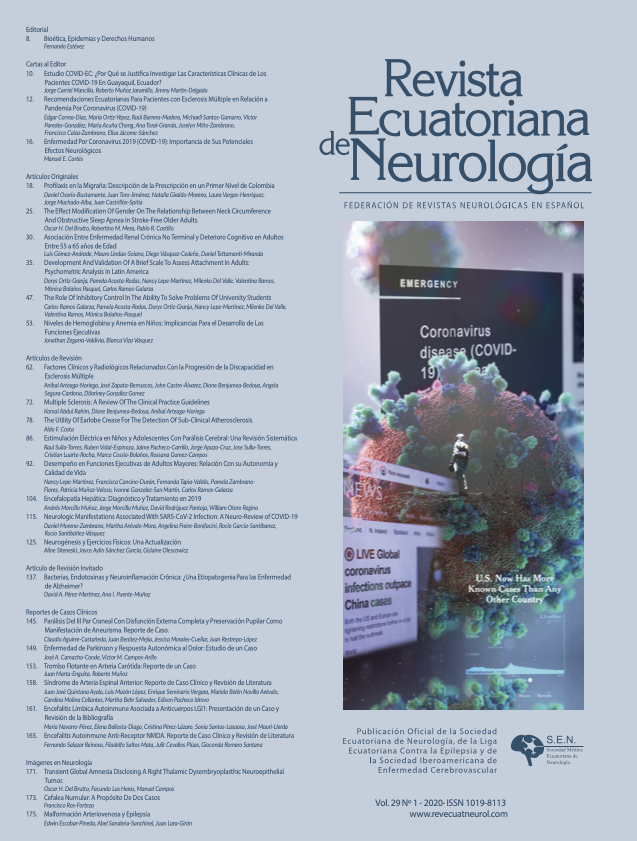
Supplementary Files
Keywords
inhibitory control
monitoring
planning
problem-solving
How to Cite
Abstract
The aim of the present study was to analyze the role of inhibitory control in the ability to solve problems of university students. The sample consisted of 90 young people with typical development (Mage= 20.58, SD= 1.27), 39 females (43.33%) and 51 males (56.7%). The Stroop and the Anillas’ Test tasks were applied as instruments. As results, it was found a directly proportional and predictive relationship between inhibitory control and problem-solving of university students (correlation between: r= .34 and .47, p= <.01; prediction: r2= .14, F(1,88)= 13.88, p= <.01). It concludes by reflecting on the contribution of conscious control to solve problems faced by the university student on a day-to-day basis in an efficient way and invites future research in order to train inhibitory control.
Most read articles by the same author(s)
- Nancy Lepe-Martínez, Diogo Besserra-Lagos, Carlos Ramos-Galarza, The executive functions of the frontal lobe and its association with the academic performance of students in higher education. , Revista Ecuatoriana de Neurología: Vol. 27 No. 3 (2018): Revista Ecuatoriana de Neurología
- Carlos Ramos-Galarza, Patricio Benavides-Endara, Mónica Bolaños-Pasquel, Silvio Fonseca-Bautista, David Ramos, Scale of clinical observation to valuate the third functional unit of the Luria theory: EOCL-1. , Revista Ecuatoriana de Neurología: Vol. 28 No. 2 (2019): Revista Ecuatoriana de Neurología
- Carlos Ramos-Galarza, Pamela Acosta-Rodas, Claudia Pérez-Salas, Valentina Ramos, Inhibitory control and symptomatology of attention deficit hyperactivity disorder. , Revista Ecuatoriana de Neurología: Vol. 28 No. 3 (2019): Revista Ecuatoriana de Neurología
- Nancy Lepe-Martínez, Francisca Cancino-Durán, Fernanda Tapia-Valdés, Pamela Zambrano-Flores, Patricia Muñoz-Veloso, Ivonne Gonzalez-San Martín, Carlos Ramos-Galarza, Executive functions performance in old adults: Relationship with autonomy and quality of life. , Revista Ecuatoriana de Neurología: Vol. 29 No. 1 (2020): Revista Ecuatoriana de Neurología
- Carlos Ramos-Galarza, Pamela Acosta-Rodas, Janio Jadán-Guerrero, César Byron Guevara-Maldonado, Mireya Zapata-Rodríguez, Diego Apolo-Buenaño, Neuropsychological assessment of attention: Symbols and digits test. , Revista Ecuatoriana de Neurología: Vol. 27 No. 1 (2018): Revista Ecuatoriana de Neurología
- Dorys Ortiz-Granja, Pamela Acosta-Rodas, Nancy Lepe-Martínez, Milenko Del Valle, Valentina Ramos, Mónica Bolaños Pasquel, Carlos Ramos-Galarza, Development and validation of a brief scale to assess attachment in adults: Psychometric analysis in Latin America. , Revista Ecuatoriana de Neurología: Vol. 29 No. 1 (2020): Revista Ecuatoriana de Neurología
- Carlos Ramos-Galarza, Carla Villegas, Dorys Ortiz, Andrés García, Mónica Bolaños, Pamela Acosta, Nancy Lepe, Milenko Del Valle, Valentina Ramos, Evaluation of the skills of the prefrontal cortex: The Efeco II-VC and II-VR. , Revista Ecuatoriana de Neurología: Vol. 27 No. 3 (2018): Revista Ecuatoriana de Neurología
- Nancy Lepe-Martínez, Claudia Pérez-Salas, Cristian A. Rojas-Barahona, Carlos Ramos-Galarza, Executive functions in preschool children with and without language disorders. , Revista Ecuatoriana de Neurología: Vol. 26 No. 3 (2017): Revista Ecuatoriana de Neurología.
- Dorys Ortiz-Granja, Pamela Acosta-Rodas, Nancy Lepe-Martínez, Milenko Del Valle, Carlos Ramos-Galarza, Scale reduced to value the sense of coherence: SOC 15. , Revista Ecuatoriana de Neurología: Vol. 28 No. 2 (2019): Revista Ecuatoriana de Neurología
- Edenia López-Hernández, Pamela Acosta-Rodas, Jorge Cruz-Cárdenas, Carlos Ramos-Galarza, Music therapy intervention for memory, attention, and language in children with dyslalia , Revista Ecuatoriana de Neurología: Vol. 30 No. 2 (2021): Revista Ecuatoriana de Neurología
