Supplementary Files
Keywords
acute challenge
apomorphine
ethanol
levodopa
therapeutic tests
apomorphine
ethanol
levodopa
therapeutic tests
How to Cite
Rodríguez-Violante, M., Cervantes-Arriaga, A., Pérez-González, V., Alcocer-Salas, Ángel, Balderas-Juárez, Ángel, Navarro-Roa, C., & Zuazua-Vidal, L. (2021). Therapeutic tests for the diagnosis of movement disorders. Revista Ecuatoriana De Neurología, 28(1). Retrieved from https://revecuatneurol.temp.publicknowledgeproject.org/index.php/revecuatneurol/article/view/1807
Abstract
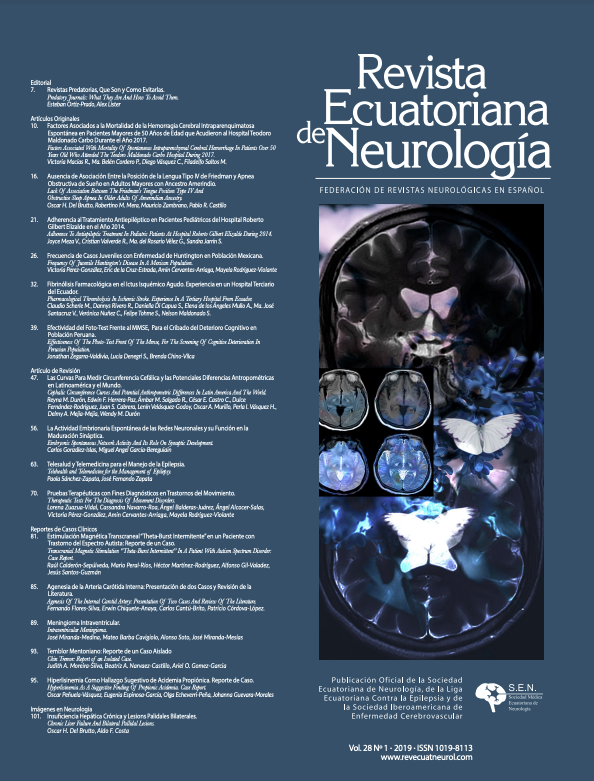
The diagnosis in medicine has its cornerstone in obtaining the clinical history and in the physical examination. However, in some of the pathologies the use of diagnostic tests is very useful as a support to confirm or rule out a disease. Diagnostic tests include a wide variety of procedures and these include therapeutic tests, also called challenges, in which an active substance is administered to evaluate the response and support the presumptive diagnosis. In the context of movement disorders, the most frequently used therapeutic tests are those with levodopa, apomorphine and ethanol. In this review we present, describe and discuss the scope and usefulness of these challenges.